> ## Documentation Index
> Fetch the complete documentation index at: https://atlas.rebuildingus.org/docs/llms.txt
> Use this file to discover all available pages before exploring further.
# Trust and provenance
> How to understand Atlas evidence, source confidence, stale data, corrections, and limits.
Trust is the core Atlas experience. The product publishes information about
real people and organizations, so every useful record must make the evidence
visible enough for a user to inspect it before acting.
Atlas should never ask you to believe a profile because it appears in Atlas.
It should show what it knows, how it knows it, and where the record may still
be partial, stale, or uncertain.
## What Atlas knows
Atlas records can describe public civic actors:
| Record type | Examples |
| ------------ | ---------------------------------------------------------------------------------------------------- |
| Person | An organizer, journalist, researcher, founder, public-interest technologist, or community leader. |
| Organization | A nonprofit, advocacy group, union local, cooperative, newsroom, public agency, or civic tech group. |
| Initiative | A program, coalition, campaign arm, mutual-aid effort, service line, or recurring project. |
| Campaign | A time-bound advocacy, electoral, ballot, fundraising, or public pressure campaign. |
| Event | A public meeting, summit, training, hearing, march, forum, or recurring civic gathering. |
A record can include a place, issue areas, short description, source links,
source dates, public contact surface, related actors, and workspace artifacts
such as briefs or coverage targets.
## How Atlas knows it
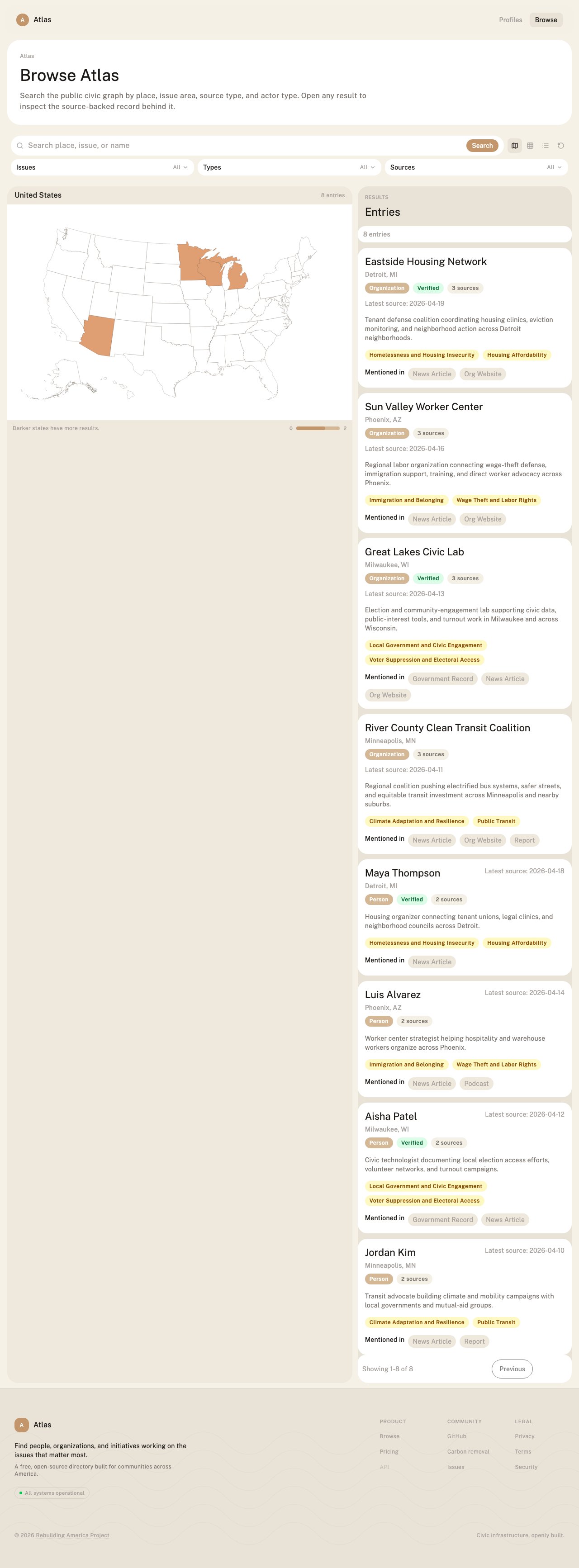
Atlas connects each claim to public evidence. A source can be a local news
article, organization website, public record, nonprofit directory, coalition
list, report, podcast page, campaign page, or other public material.
When you inspect a record, look for:
* **Source title:** The document or page that mentioned the actor.
* **Publication or publisher:** Who published the source.
* **URL:** Where you can verify the source yourself.
* **Date:** When the source was published or when Atlas saw it.
* **Source type:** Journalism, organization website, directory, public record,
report, podcast, or another category.
* **Extraction context:** The sentence, row, paragraph, or page fragment that
explains why Atlas connected the source to the actor.
 ## What source evidence means
Source evidence means Atlas found public material that supports showing the
record. It does not automatically mean the source is complete, independent,
current, neutral, or correct.
Use this reading model:
| Evidence state | What it means | How to use it |
| ---------------------------- | ------------------------------------------------------------------------------- | ------------------------------------------------------------------------------------- |
| Single source | Atlas found one public mention or page. | Treat it as a lead. Open the source before outreach or publication. |
| Multiple independent sources | Several sources mention the same actor or work. | Higher confidence, especially when sources come from different publishers. |
| Recent source | The source was published or observed recently. | More actionable, but still verify before high-stakes use. |
| Old source | The strongest evidence is months or years old. | Treat activity, contact, and role as uncertain until refreshed. |
| Structured source | The evidence is a roster, table, directory row, partner list, or contact block. | Good for existence and affiliation; weaker for describing impact or current activity. |
| Partial source | The source supports only part of the profile. | Do not infer unsupported details. Read the specific evidence. |
## Stale, partial, and uncorroborated data
Atlas should make uncertainty visible instead of smoothing it over.
**Stale data** means the best source evidence may no longer describe the
current state. A profile can still be useful as a research lead, but the user
should not assume the person has the same role, the organization is active, or
the contact surface still works.
**Partial data** means Atlas knows some things but not others. A source may
prove that an organization exists in Phoenix and works on wage theft, but not
prove its current staff, funding, coalition partners, or service area.
**Uncorroborated data** means the record has limited independent support. One
source may be enough to show a lead, but not enough to treat the profile as a
settled account of an actor's work.
## How corrections work
Atlas supports correction pathways because public data about people can be
wrong, stale, duplicated, overbroad, or missing context.
Users can flag:
* Incorrect names, descriptions, locations, issue tags, or actor types.
* Broken, stale, misattributed, or low-quality sources.
* Duplicate profiles that should be merged.
* Records that should not be public.
* Missing context that changes how a record should be understood.
Flags are reviewed by maintainers or workspace operators before they change the
public record. A correction should improve the user experience by making the
profile more accurate, more clearly sourced, or more honest about uncertainty.
## What Atlas explicitly does not claim
Atlas does not:
* Endorse a person, organization, campaign, or issue position.
* Decide that one actor is more important than another.
* Verify every statement inside every source.
* Guarantee that a person is currently active, reachable, or in the same role.
* Publish private workspace notes as public evidence.
* Treat a team workflow as proof that a public claim is true.
* Replace local knowledge, direct verification, or editorial judgment.
The safest way to use Atlas is to treat it as a source-linked discovery layer:
it helps you find leads, understand why they surfaced, and decide what needs
human review next.
## Public and private evidence
Public Atlas records are built from public evidence. Workspace artifacts such
as private lists, briefs, coverage targets, notes, usage proof, and renewal
packets belong to the workspace unless a user deliberately publishes a
public-safe record.
This boundary matters. A public user should not have to trust a claim that only
exists inside an enterprise workflow. A workspace user should not have to worry
that private planning context will leak into the public map.
## Before acting on a record
Use this checklist before outreach, publication, funding review, or public
claims:
1. Open the profile and read the source panel.
2. Check whether the strongest evidence is recent.
3. Look for more than one independent source when the use is high-stakes.
4. Confirm that the source actually supports the specific claim you plan to
repeat.
5. Treat contact information, roles, and current activity as provisional unless
the evidence is recent and direct.
6. File a correction if the profile is wrong, stale, duplicated, or misleading.
## Related guides
How public evidence becomes searchable profiles.
Practice inspecting source evidence in a public search.
Use the API to inspect evidence and submit corrections.
Understand visibility, `entry_links`, and workspace-scoped data.
## What source evidence means
Source evidence means Atlas found public material that supports showing the
record. It does not automatically mean the source is complete, independent,
current, neutral, or correct.
Use this reading model:
| Evidence state | What it means | How to use it |
| ---------------------------- | ------------------------------------------------------------------------------- | ------------------------------------------------------------------------------------- |
| Single source | Atlas found one public mention or page. | Treat it as a lead. Open the source before outreach or publication. |
| Multiple independent sources | Several sources mention the same actor or work. | Higher confidence, especially when sources come from different publishers. |
| Recent source | The source was published or observed recently. | More actionable, but still verify before high-stakes use. |
| Old source | The strongest evidence is months or years old. | Treat activity, contact, and role as uncertain until refreshed. |
| Structured source | The evidence is a roster, table, directory row, partner list, or contact block. | Good for existence and affiliation; weaker for describing impact or current activity. |
| Partial source | The source supports only part of the profile. | Do not infer unsupported details. Read the specific evidence. |
## Stale, partial, and uncorroborated data
Atlas should make uncertainty visible instead of smoothing it over.
**Stale data** means the best source evidence may no longer describe the
current state. A profile can still be useful as a research lead, but the user
should not assume the person has the same role, the organization is active, or
the contact surface still works.
**Partial data** means Atlas knows some things but not others. A source may
prove that an organization exists in Phoenix and works on wage theft, but not
prove its current staff, funding, coalition partners, or service area.
**Uncorroborated data** means the record has limited independent support. One
source may be enough to show a lead, but not enough to treat the profile as a
settled account of an actor's work.
## How corrections work
Atlas supports correction pathways because public data about people can be
wrong, stale, duplicated, overbroad, or missing context.
Users can flag:
* Incorrect names, descriptions, locations, issue tags, or actor types.
* Broken, stale, misattributed, or low-quality sources.
* Duplicate profiles that should be merged.
* Records that should not be public.
* Missing context that changes how a record should be understood.
Flags are reviewed by maintainers or workspace operators before they change the
public record. A correction should improve the user experience by making the
profile more accurate, more clearly sourced, or more honest about uncertainty.
## What Atlas explicitly does not claim
Atlas does not:
* Endorse a person, organization, campaign, or issue position.
* Decide that one actor is more important than another.
* Verify every statement inside every source.
* Guarantee that a person is currently active, reachable, or in the same role.
* Publish private workspace notes as public evidence.
* Treat a team workflow as proof that a public claim is true.
* Replace local knowledge, direct verification, or editorial judgment.
The safest way to use Atlas is to treat it as a source-linked discovery layer:
it helps you find leads, understand why they surfaced, and decide what needs
human review next.
## Public and private evidence
Public Atlas records are built from public evidence. Workspace artifacts such
as private lists, briefs, coverage targets, notes, usage proof, and renewal
packets belong to the workspace unless a user deliberately publishes a
public-safe record.
This boundary matters. A public user should not have to trust a claim that only
exists inside an enterprise workflow. A workspace user should not have to worry
that private planning context will leak into the public map.
## Before acting on a record
Use this checklist before outreach, publication, funding review, or public
claims:
1. Open the profile and read the source panel.
2. Check whether the strongest evidence is recent.
3. Look for more than one independent source when the use is high-stakes.
4. Confirm that the source actually supports the specific claim you plan to
repeat.
5. Treat contact information, roles, and current activity as provisional unless
the evidence is recent and direct.
6. File a correction if the profile is wrong, stale, duplicated, or misleading.
## Related guides
How public evidence becomes searchable profiles.
Practice inspecting source evidence in a public search.
Use the API to inspect evidence and submit corrections.
Understand visibility, `entry_links`, and workspace-scoped data.